
Machine Translation vs. Human Translation: Which is Right for Your Business?
Global organizations today produce more multilingual content than ever before: product documentation, support materials, contracts, marketing campaigns, and internal communications. As translation volumes increase, many companies face the same question: machine translation vs. human translation: what’s the right choice for your business?
The discussion is often framed as technology replacing people. However, the decision is a more strategic one. Enterprises must evaluate risk, quality requirements, and business impact. Some content requires precision and regulatory compliance, while other materials simply need to be understandable quickly.
That’s why many global organizations are moving toward fit-for-purpose translation strategies, choosing the right approach based on the type of content being translated. Increasingly, that means combining machine translation engines or AI-powered translation with human expertise in structured workflows.
At Seprotec Multilingual Solutions, this philosophy guides how we design translation workflows. Through seprotec.ai, organizations can integrate AI translation with professional machine translation post-editing (MTPE), ensuring speed where possible and human oversight where quality matters most.
Machine Translation vs. Human Translation: What’s the Difference for Businesses?
Machine translation uses AI software to automatically translate text, while human translation relies on professional linguists who interpret context, terminology, and cultural nuance.
What is Machine Translation?
Machine translation (MT) refers to automated translation generated by software systems. Most modern MT systems use neural machine translation (NMT) models that predict language patterns and generate translations based on learned linguistic relationships. More recently, large language models (LLMs) have expanded translation capabilities by producing fluent, natural-sounding output across many language pairs.
Machine translation offers several advantages: high speed and scalability; the ability to translate large volumes of content quickly; lower cost per word when integrated into optimized workflows; and immediate availability for multilingual operations.
However, machine translation or AI translations also have limitations. They may struggle with terminology-sensitive content, ambiguous phrasing, or legal and regulatory language. That’s why enterprises typically achieve better results when MT is used as part of a controlled workflow.
What is Human Translation?
Human translation is performed by professional linguists who understand both language and context. These translators often specialize in specific domains such as law, life sciences, engineering, or intellectual property.
Human translators bring capabilities to the table that AI cannot fully replicate, including: interpreting intent, tone, and context; applying domain-specific terminology; identifying inconsistencies or ambiguities in the source text; and making informed linguistic and cultural judgments.
Key Differences that Matter for Enterprises
Accuracy and Contextual Understanding
Machine translation or AI translation can perform well with straightforward content, particularly in common language pairs and familiar domains. However, challenges arise when texts contain complex sentence structures, specialized terminology, legal language, or safety-critical instructions.
Speed and Scalability
Machine translation and AI translation can process thousands of words in minutes, making them ideal for high-volume or time-sensitive workflows. Human translation involves multiple stages including research, drafting, review, and quality assurance.
Cost and Operational Efficiency
Machine or AI-enabled translation can reduce costs when integrated with translation memories, terminology management, and quality evaluation processes. Without these controls, however, low-quality MT output may end in rework and operational risk.
Data Security and Confidentiality
Sensitive materials such as contracts, product designs, or intellectual property require secure translation environments. Enterprises increasingly require controlled workflows and secure platforms for AI translation.
Three standards you should look for when hiring a professional translation services partner:
- ISO 17100 — requirements for translation service processes and resources (quality-focused translation delivery)
- ISO 18587 — requirements for machine translation post‑editing (MTPE)
- ISO/IEC 27001 — requirements for information security management systems (ISMS)
A Risk-Based Decision Framework for Translation
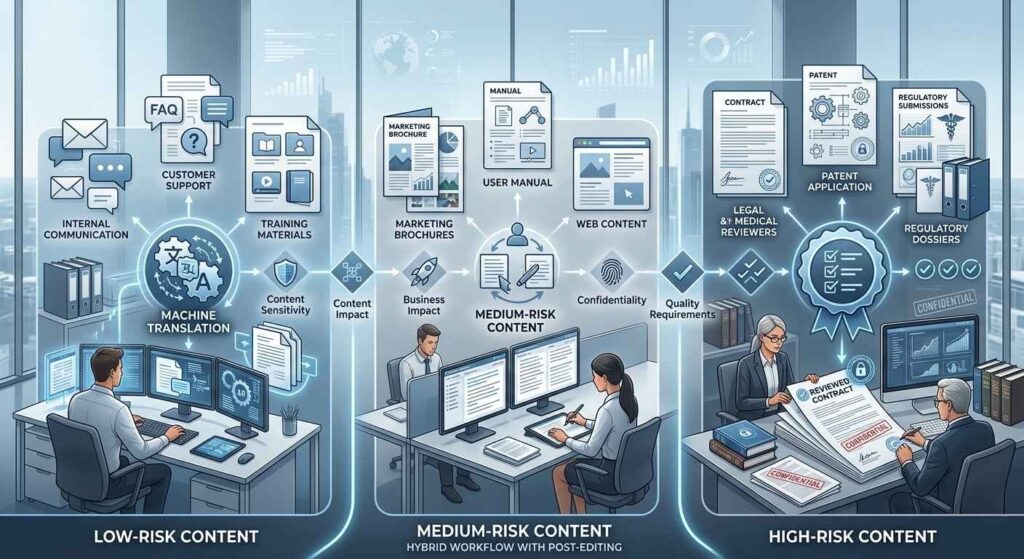
Rather than choosing one approach for all content, many organizations adopt a risk-based decision framework based on the concept of fit-for-purpose translation quality.
Key evaluation factors include:
- Business impact if incorrect
- Regulatory exposure
- Sensitivity of the terminology
- Confidentiality or IP protection
- Volume and urgency
| Content Risk Level | Recommended Approach |
| Low | Machine translation |
| Medium | Hybrid workflow (MT + human post-editing) |
| High | Human translation with review |
When Machine Translation Works Best
Organizations often use machine translation for high-volume, low-risk content such as:
- Internal communications
- Customer support triage
- Knowledge base drafts
- Meeting summaries
- Early-stage research
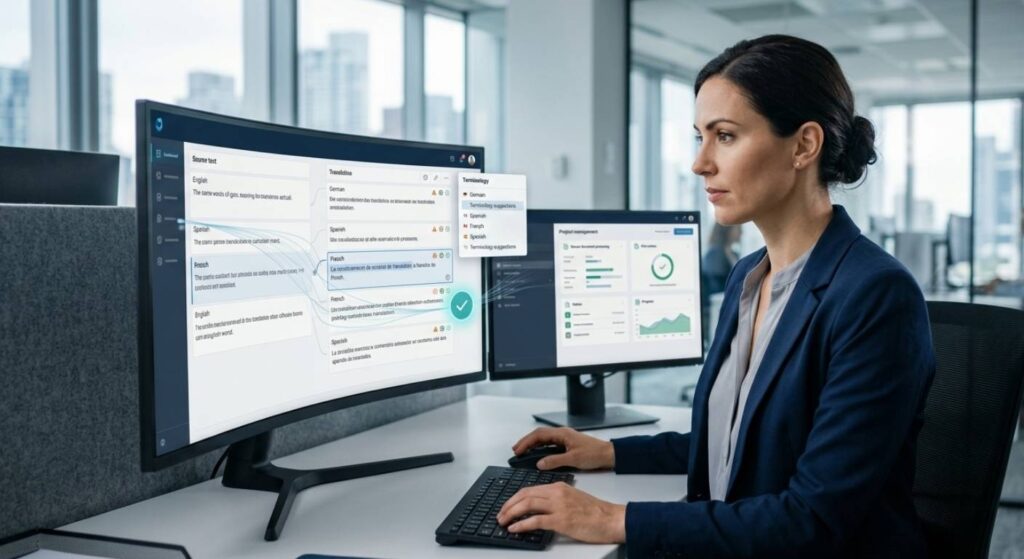
Platforms like seprotec.ai allow organizations to implement AI translation workflows with terminology management and quality control.
When Human Translation is Essential
Human translation remains essential for high-impact or regulated content including:
- Contracts and legal documentation
- Patents and intellectual property filings
- Clinical or medical documentation
- Compliance and regulatory materials
- Creative marketing messaging
Professional linguists ensure contextual accuracy and alignment with standards such as ISO 17100 and ISO 18587.
The Hybrid Approach: Combining AI Speed with Human Expertise
For many companies, the debate around machine translation vs. human translation is no longer about choosing one approach over the other but about combining them within structured translation workflows.
Hybrid workflows combine machine translation with human post-editing and expert validation. This approach balances scalability and quality by applying human expertise where it matters most.
Industry organizations such as TAUS (Translation Automation User Society) have long documented how machine translation combined with professional post-editing can significantly improve translation productivity.
Through seprotec.ai, for example, Seprotec Multilingual Solutions enables enterprises to implement AI translation workflows with human MTPE integrated into the process.
Choosing the Right Translation Strategy for Your Business
The debate around machine translation vs. human translation is not about choosing technology over expertise. Instead, organizations should align translation workflows with business risk, content complexity, and operational scale.
In practice, many businesses achieve the best results with hybrid translation workflows that combine AI efficiency with professional language oversight.
By choosing the right approach for each content type, companies can scale multilingual communication while maintaining accuracy, consistency, and regulatory compliance.
If your organization is evaluating machine translation vs. human translation, a translation risk audit can help identify which workflow delivers the best balance of speed, quality, and cost. If you’re looking for a starting point, you can download our fit-for-purpose quality matrix for inspiration or book a free consultation with our experts.
FAQ: machine translation vs. human translation
Is machine translation accurate enough for business use?
Yes, machine translation can be accurate for many business uses, especially for high-volume, low-risk content such as internal communications or support materials. Modern AI systems produce fluent translations in common language pairs.
However, specialized or high-stakes content often requires human review or post-editing to ensure terminology accuracy and contextual correctness.
Can AI replace professional translators?
AI can automate some translation tasks, but it cannot fully replace professional translators. Human linguists provide cultural understanding, subject-matter expertise, and judgment when handling complex or sensitive content.
In most enterprise environments, AI works best when combined with human review and quality assurance.
How can I protect confidential data when using AI translation?
To protect sensitive information, organizations should use secure translation platforms rather than public AI tools.
Best practices include using controlled environments, defining clear data retention policies, and working with providers that follow security standards such as ISO/IEC 27001.


There are no comments
Leave a comment