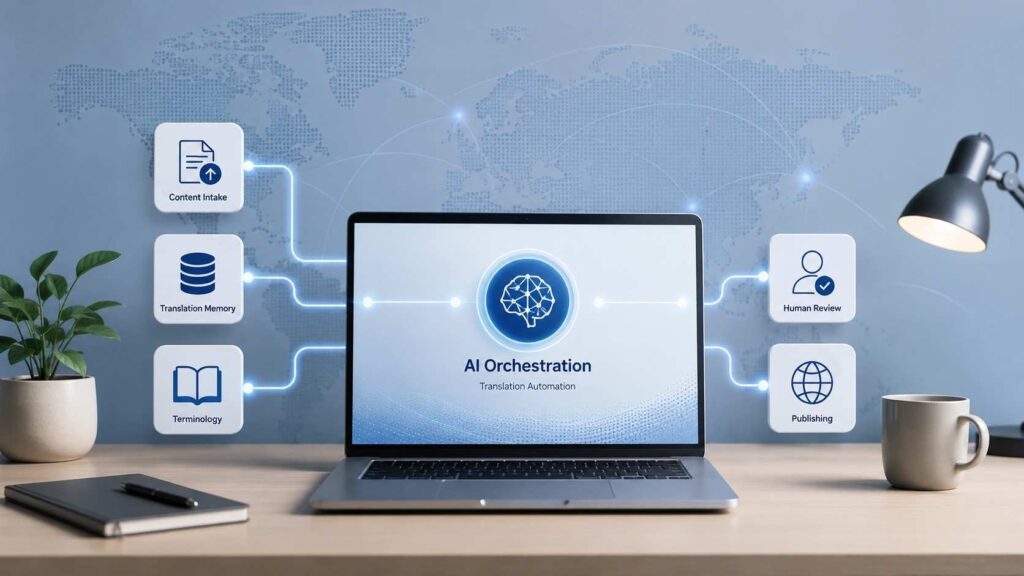
Translation Automation as part of the AI Translation Ecosystem – How orchestration turns automation into real gains in time, cost, and value
Most enterprises adopting AI in translation start with a checklist: which content to automate, which engine to use, when to require human review. Checklists are useful — they force a company to ask the right questions. But they also share a blind spot: they treat translation automation as a list of individual decisions, when in practice, none of those decisions works in isolation.
Choosing an MT engine matters less if terminology governance is inconsistent. Automating file routing matters less if quality thresholds are undefined. And AI, however well selected, becomes another disconnected tool if it isn’t orchestrated with everything else already in place — the business management platform, the linguistic technology, the human review layer.
This is the shift the industry is going through right now: from automating individual tasks to orchestrating an entire multilingual ecosystem. And it’s where the real gains in time, cost, and value come from.
Why Automation on its Own Falls Short
Translation automation is often confused with machine translation. It isn’t the same thing. Machine translation is one component among several of automation, which is the orchestration of the full lifecycle — intake, routing, translation, quality control, review, delivery, and publishing — as a governed, integrated process rather than a series of manual handoffs.
When companies automate one piece of this lifecycle without connecting it to the rest, the result is a familiar pattern: separate tools for project management, translation memory, MT, and reporting, each doing its job well but none of them talking to each other. Content volumes grow, language pairs multiply, and the coordination effort grows with them — often faster than the efficiency gains that automation was supposed to deliver.
This is precisely the kind of fragmentation that a genuine ecosystem approach is designed to solve.
The Three Layers of a Modern Translation Ecosystem
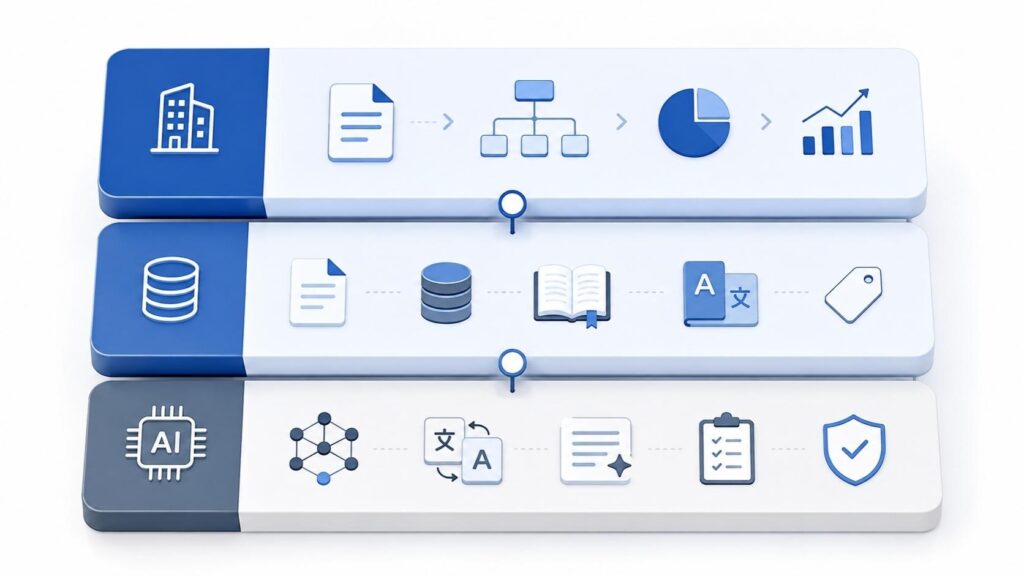
- Seprotec’s AI-Powered Multilingual Ecosystem is structured around three layers that work together rather than in parallel: Translation Business Management System — the layer that handles quoting, project creation, vendor and resource assignment, invoicing, and reporting. This is where a request becomes a governed project with a defined workflow, budget, and timeline.
- Language Technology — the CAT environment, translation memories, and terminology databases that ensure linguistic consistency across projects, languages, and years of accumulated content.
- Seprotec AI Solutions — the layer where engine selection, automated quality estimation (AQE), automated post-editing (APE), and LLM-based language processing are applied, under human-in-the-loop supervision when applicable and desired.
None of these layers is new in itself. What changes the outcome is the orchestration and automation layer that sits above them, connecting client content sources — CMS, PIM, repositories, request channels — directly into this ecosystem through integrations and routing rules, with governance, approvals, and security policies applied consistently from the moment content enters the pipeline until it’s published.
This orchestration is what turns three separate capabilities into one coordinated system — and it’s also where most of the measurable efficiency comes from.
Where Translation Automation Delivers Time and Cost Efficiency
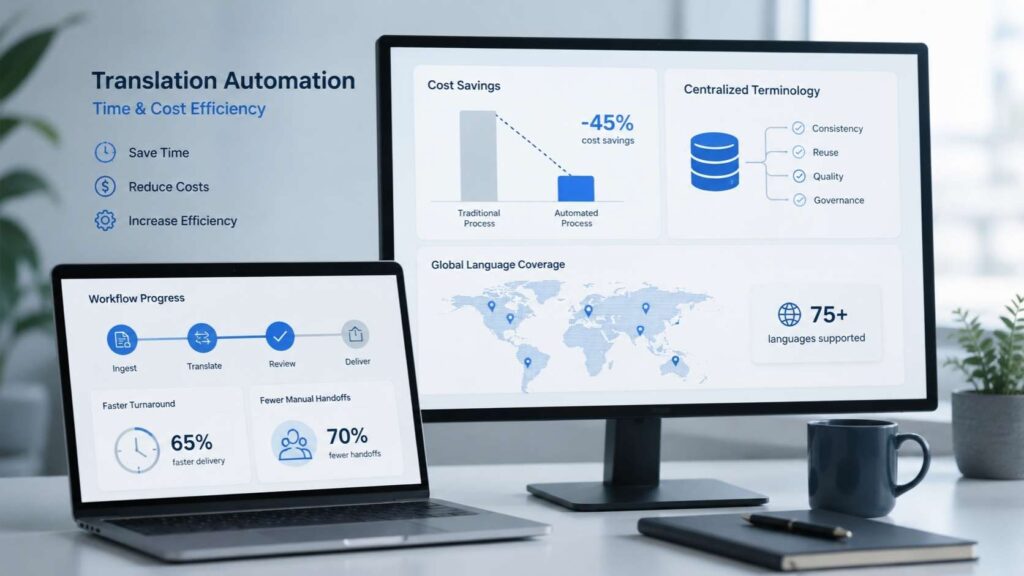
It’s tempting to credit only AI translation itself for the efficiency gains enterprises are achieving. In practice, most of the measurable savings come from what happens around the AI models:
Fewer manual handoffs
When content moves automatically between the business management system, the language technology, and the AI layer, instead of through email requests and manual file transfers, turnaround time drops without any change to translation quality.
Engine and workflow selection by content, not by default
Not all content needs the same treatment. Regulated, high-visibility, or contractual content still requires full human translation and review. High-volume, lower-risk content — product listings, support articles, internal documentation — can move through AI-governed workflows with quality estimation and automated post-editing. Matching the workflow to the content, instead of applying one standard process to everything, is where real cost control comes from.
Terminology governed centrally
One of the most common — and most expensive — inefficiencies in enterprise translation comes from parallel glossaries maintained by different teams. When terminology is enforced consistently across every workflow, rework and quality escalations fall measurably, and this reduction shows up directly in cost per word and time-to-delivery.
Consolidated tooling
Replacing a fragmented landscape of point solutions with one coordinated ecosystem reduces licensing complexity and administrative overhead — savings that rarely appear in a per-project quote, but which accumulate significantly at enterprise scale.
Where AI Adds Value, Not Just Speed
Efficiency is only part of the story. The more interesting shift is where AI is enabling services that didn’t exist as scalable offerings before:
Private, governed AI environments for sensitive content
For regulated, confidential, or IP-sensitive material, public AI tools are not an option. Seprotec supports private processing environments designed to keep sensitive content out of public training pipelines while still benefiting from AI-assisted translation and quality estimation — extending AI’s efficiency to content that previously had to remain fully manual for security reasons.
AI-supported quality evaluation as a decision layer, not just a filter
Automated quality estimation doesn’t only decide whether a segment needs post-editing — used well, it becomes a live signal for where human expertise should be concentrated, letting linguists spend their time on the content that actually needs it: technical documentation, legal and contractual material, and life sciences content, where accuracy has real consequences.
AI-enhanced services beyond translation
As Seprotec’s multilingual ecosystem spans translation, interpreting, and intellectual property language services. AI is extending value into each of these areas — from technology-assisted interpreting support to AI-assisted terminology and quality workflows for IP and patent-related content, where consistency and precision carry particular weight.
Business intelligence built into the workflow
Because the ecosystem’s business management, language technology, and AI layers are connected, reporting and dashboards can show real-time cost, quality, and throughput data across markets and content types.
A Resolutely Technology-Agnostic Approach
None of this depends on committing to a single technology or a single AI model. Language pairs, content types, and quality requirements all call for different tools, and the market is continuously evolving. Seprotec’s approach is future-proof: we continuously evaluate and select the best available technology for each use case, keeping the ecosystem’s architecture stable while its components evolve. In this way our clients get the benefit of innovation without having to re-design their workflows every time the technology landscape shifts.
This is also why governance matters as much as capability. Seprotec’s processes align with ISO 9001, ISO 17100, ISO 18587, ISO 13485, ISO 14001, and ISO 27001 — covering quality management, translation services, post-editing, medical devices documentation, environmental management, and information security. For enterprises adopting AI in regulated or high-stakes environments, this certification framework makes automation auditable as well as fast.
From Translation Automation Checklist to Ecosystem
A checklist can tell an organization what to consider before adopting a modern up-to-date approach towards translation in the era of AI. It can’t tell them how those decisions interact once they’re implemented — and that interaction is where most of the value (or friction) actually comes from.
With more than 25 years of experience as a language intelligence partner, Seprotec’s role is to support that interaction: connecting business management, language technology, and AI solutions into a single governed ecosystem through Seprotec’s AI-Powered Multilingual Ecosystem. This coordinated approach allows translation automation to compound rather than fragment, and ensures that AI is introduced where it genuinely adds time, cost, or service value — not simply because it’s available.
If you’d like to assess how your current translation workflows could be structured into an orchestrated, AI-ready language ecosystem, we’d be happy to walk through it with you.
Key Questions About AI Translation Ecosystems
What is an AI-powered translation ecosystem?
An AI-powered translation ecosystem connects business management, language technology, AI solutions, and human review into a coordinated workflow. Rather than automating individual translation tasks, it orchestrates the full lifecycle from content intake and routing to quality control, delivery, and publishing.
How does translation automation improve time and cost efficiency?
Translation automation reduces manual handoffs, streamlines content routing, and matches workflows to the risk and requirements of each content type. Centralized terminology and consolidated technology can further reduce rework, administrative overhead, and time-to-delivery.
What is the difference between AI translation and translation automation?
AI translation is one component of a broader automated translation workflow. Translation automation coordinates multiple stages of the process, including content intake, routing, AI or machine translation, quality estimation, post-editing, human review, and delivery.
When should human review be included in an AI translation workflow?
Human review remains important for regulated, contractual, high-visibility, and other high-risk content where accuracy and context are critical. AI-supported quality estimation can help identify where linguistic expertise should be concentrated.
How can enterprises implement AI translation without replacing their existing technology?
A technology-agnostic approach allows organizations to connect existing business management systems, CAT tools, translation memories, terminology databases, and content sources with AI capabilities. This makes it possible to introduce AI while keeping the overall workflow and governance framework stable.
Transparency Notice
Artificial intelligence tools may be used to support the creation of some of the content published on this blog. All content is reviewed, adapted, verified, and approved by the Seprotec team, which assumes editorial responsibility for its publication.


There are no comments
Leave a comment