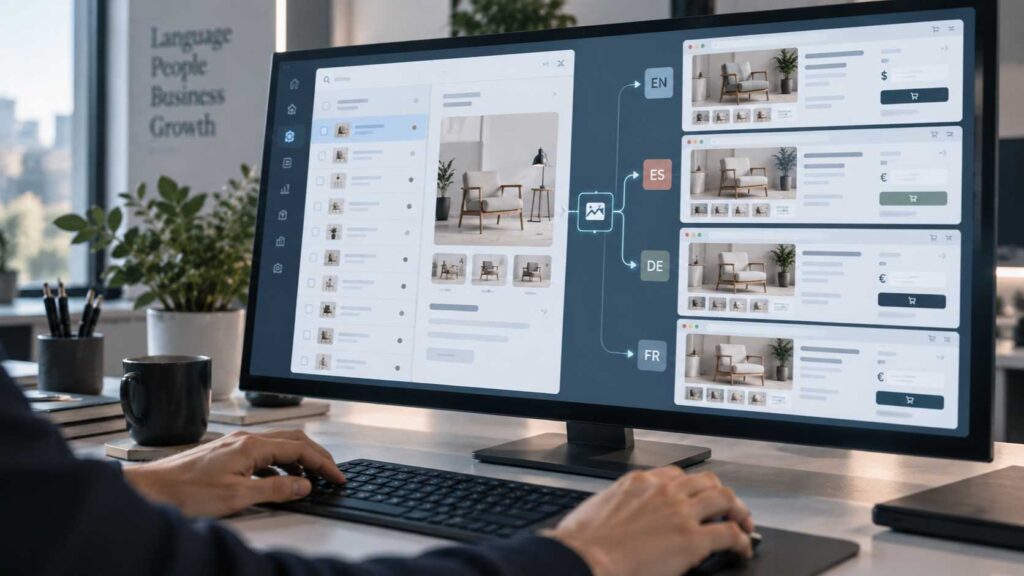
How product localization helps companies enter new international markets
A product built for one market rarely performs the same way the moment it reaches another, even when the translation itself is accurate. For companies expanding into new territories, and increasingly for e-commerce brands managing catalogs across dozens of storefronts at once, product localization is what turns a translated product into one that performs in its target market.
We work with product and e-commerce teams building localization programs around AI-driven translation at scale. This guide covers what product localization involves, how the process works, and what a program built for quality and volume looks like.
What is product localization?

Product localization is the adaptation of a product, its interface, documentation, packaging, and supporting content, for the linguistic, cultural, and regulatory expectations of a specific market. It differs from translation in scope: translation converts the text, while localization also adjusts formats, imagery, and functionality. For an e-commerce catalog, that means product titles and descriptions matched to local search behavior, not simply translated copy.
Why product localization determines market entry success
User expectations and first impressions in new markets
Users form an impression of product quality within the first interaction, and a product that reads as translated rather than native undermines that impression. In e-commerce, a product page has seconds, not minutes, to establish credibility with a new visitor.
Regulatory and compliance requirements by product category and jurisdiction
Certain product categories carry legal localization requirements, not only commercial ones. Consumer electronics, medical devices, and food products are subject to labeling and disclosure rules that vary by jurisdiction, and non-compliant localization can delay market entry.
The revenue cost of under-localized products
An under-localized product does not fail visibly; it underperforms quietly, in terms of lower conversion, higher returns, and a support volume a home market team struggles to explain. In e-commerce, that underperformance is usually cheaper to prevent than to diagnose after launch.
Product localization by product type
Software and SaaS product localization
Software products generate a continuous stream of interface strings, release notes, and help content that needs to stay synchronized with frequent releases. Machine translation with human post-editing, customized to the product’s terminology, keeps pace with that velocity without a proportional increase in cost.
Mobile applications
Mobile apps add character constraints, right-to-left language support, and app store listing localization to the standard software requirements. Store listings function as a product’s first marketing surface and deserve the same attention as the in-app content.
Hardware, consumer electronics, and physical products
Physical products carry localization requirements that persist after the sale: manuals, safety instructions, and regulatory labeling all need to be accurate in the target language, since an error here is a liability exposure rather than a quality inconvenience.
Packaging and labeling for regulated markets
Packaging localization involves more than translated text. Unit conversions, mandatory disclosures, and certification marks vary by market, and getting them wrong can hold a shipment at customs regardless of how the product performs.
The product localization process
Internationalization (i18n) as the foundation
Internationalization is the engineering work that makes a product capable of being localized: separating text from code and supporting variable string lengths and character sets. Products built without it generate significantly higher localization costs later, since changes then have to be made retroactively.
Content audit and scope definition
Before translation begins, the content that needs localizing has to be defined explicitly. Interface strings, descriptions, and marketing content carry different volumes and update frequencies, and a scope that treats them identically usually overspends on some content while underserving the rest.
Translation and cultural adaptation by language pair
Translation quality varies by language pair and content domain, and a program built for one pair does not automatically perform the same way in another. Cultural adaptation, adjusting imagery and tone rather than only words, matters most for customer-facing content.
In-context linguistic testing and QA
Reviewing translated content inside the actual product interface, rather than in a file export, catches errors that text-only review misses: truncated strings, mismatched context, and translations accurate in isolation but wrong in place.
Functional testing in the target locale
The localized product needs to be tested as a functioning product, not only reviewed as translated text. Date and currency formats, checkout flows, and any locale-specific functionality should be verified before launch rather than discovered by users after it.
Technology in product localization
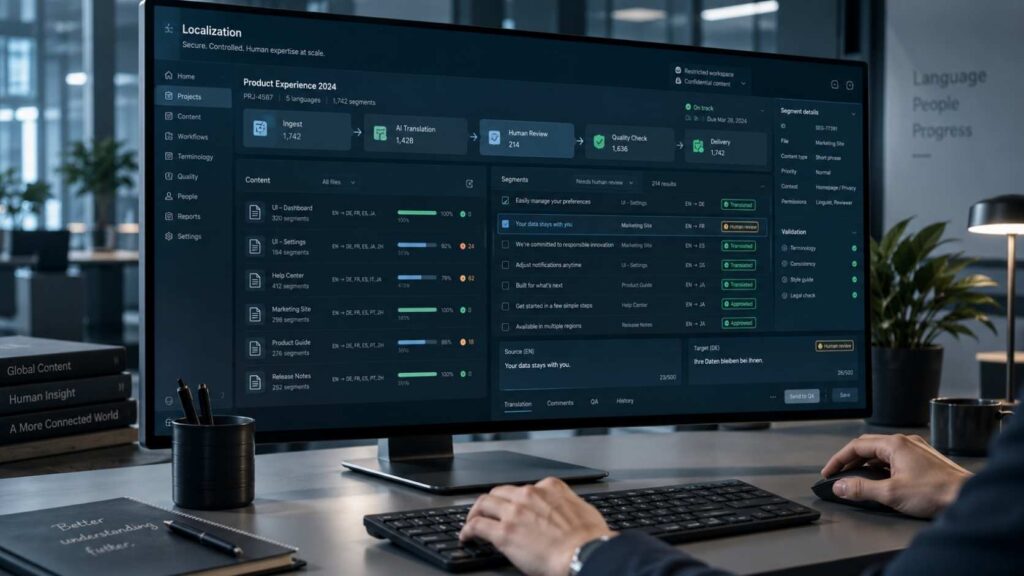
Translation management system integration with product development
A translation management system connected to the product’s content and development systems allows product localization to run as an ongoing process rather than a series of one-off projects, particularly for large content volumes such as e-commerce catalogs.
Machine translation for high-volume product content
Product catalogs, especially in e-commerce, generate translation volume that human-only translation cannot support economically at scale. We orchestrate AI models through seprotec.ai to translate product titles, descriptions, and specifications in a private, governed environment, applying human review where a category or market carries higher risk, without exposing proprietary product data to public AI tools.
Terminology management for consistency across markets and versions
A termbase governs how product names, feature names, and technical specifications are translated, ensuring the same product is described consistently across every market and catalog update, with governance integrated directly into the translation workflow rather than checked after the fact.
Common mistakes companies make in product localization
Underestimating i18n debt before localization starts
Products built without internationalization accumulate a form of technical debt that surfaces the moment localization begins: hardcoded strings, layouts that break under text expansion, and date formats built around a single market. Addressing this after the fact costs considerably more than building for it from the start.
Treating localization as a post-launch step
Companies that localize only after a product succeeds domestically often find that competitors already occupy the markets they are entering, and that retrofitting localization into a product not designed for it takes longer than building it in from the start.
Applying the same QA process to all content types
A user manual and a promotional email carry different risk profiles and should not go through identical review. Programs that apply one QA standard uniformly overprocess low-risk content while under-reviewing the content where an error would matter.
Building on a single-vendor dependency
When one vendor controls the translation memory, the termbase, and the only AI engine used, switching becomes difficult and pricing leverage shifts to the vendor. A technology-agnostic approach, with portable data and assets, avoids that dependency from the start.
What to look for in a product localization partner
Technology agnosticism and engine flexibility
A partner tied to a single machine translation engine or LLM has a structural incentive to recommend it regardless of fit. Seprotec evaluates and integrates the best-performing engine for each language pair and content type, since no single engine performs best everywhere.
Domain coverage across your product content types
Product localization spans technical documentation, marketing copy, legal disclosures, and interface strings, each requiring different translator expertise. A partner covering the full range prevents the fragmentation of managing multiple vendors for a single product line.
A private AI environment for sensitive product content
Product specifications, unreleased features, and pricing strategy should never be exposed to public AI tools that may use submitted content to train their models. seprotec.ai operates in a private, closed environment where client content stays fully controlled, a requirement for any company translating proprietary product content at volume, e-commerce catalogs included.
Program design capability, not just file delivery
At scale, particularly for e-commerce catalogs updated continuously, the deliverable should be a functioning localization program, not a series of individually delivered files. We design that program architecture as a Language Intelligence Partner, working alongside the teams that own the content.
What product teams ask about localization
How do we build the business case for product localization investment?
Frame the investment against the cost of underperformance in a specific market: lower conversion, higher returns and support volume linked to translation quality, against the cost of a properly scoped program.
In-house vs. outsourced: how do we decide?
In-house teams offer tighter alignment but face capacity limits during volume spikes, such as seasonal e-commerce campaigns. Most organizations combine an in-house owner for strategy with an external partner providing capacity and technology.
How do we evaluate a product localization vendor?
Look for technology agnosticism, a private AI environment for proprietary content, and evidence of experience in program design rather than translation delivery alone.
What does onboarding a new localization partner look like?
Onboarding typically starts with a content audit, termbase transfer, and a pilot on a limited content set before scaling to full volume. For catalog-heavy e-commerce clients, that pilot usually runs on one category first.
What are the most important languages for product localization?
There is no universal list. Language prioritization should follow market opportunity and demand data, not a generic ranking of global language size.
If you are building or scaling a product localization program, particularly across a high-volume catalog, contact us to discuss how seprotec.ai and our translation teams can support it.
Transparency Notice
Artificial intelligence tools may be used to support the creation of some of the content published on this blog. All content is reviewed, adapted, verified, and approved by the Seprotec team, which assumes editorial responsibility for its publication.


There are no comments
Leave a comment