
Translation quality assurance (TQA) is the planned, systematic set of activities that gives an organization confidence that a translated product meets its defined quality requirements before it reaches the end user.
One mistranslated term can trigger a compliance failure, force a product recall, or damage a brand that took years to build. That is why TQA is no longer a checkpoint you run at the end of a project. It governs the whole production flow, from fully human translation to AI-assisted and machine-generated content.
After more than 25 years building ISO-certified language workflows in over 220 languages, we have learned one thing above all: quality is something you design into a process, not something you inspect once the work is done. In this guide you will learn:
- What translation quality assurance really is, and how it differs from quality control.
- The errors a professional QA process catches, and the steps and tools behind it.
- How to combine AI speed with human judgment without putting confidential content at risk.
Translation Quality Assurance: Definition and Purpose
At Seprotec, quality assurance applies across our full portfolio of language services, from professional translation and interpreting to intellectual property management. The same structured, certified approach governs every service line. Under ISO 9001 and ISO 17100, quality assurance is defined as the set of planned and systematic activities designed to provide confidence that a product or service fulfills the specified quality requirements.
There is a nuance here that is often missed. QA does not mean delivering the maximum possible quality. It means guaranteeing that the agreed, predefined quality level is reached reliably, every time, across every language. A medical device manual, a marketing campaign, and a high-volume support knowledge base each carry a different quality requirement. TQA is the system that makes sure each one hits its own standard, consistently.
Put simply: Quality Assurance is the system. Quality Check is the inspection.
The Role of TQA in Professional Translation Workflows
At Seprotec, we build quality assurance into the workflow instead of bolting it on at the end. Every project we deliver follows a certified quality process, aligned with the steps agreed with the client. A typical ISO 17100-compliant flow looks like this:
- Pre-production: requirements analysis, terminology setup, style-guide development, and translator qualification checks.
- Production: the TEP workflow (Translation, Editing and Revision), with specialised subject-matter reviewers for regulated fields such as Life Sciences.
- In-process QA: automated quality checks, consistency verification, and formatting validation.
- Post-production: final review, client-specific checks, and delivery validation.
- Ongoing: LQA assessments, client feedback, performance trending, and regular quality reviews.
Quality is built in from the start, not inspected after the fact.
Translation Quality Assurance vs Translation Quality Control
People often use the two terms interchangeably, but the distinction shapes how you run an entire language programme.
| Quality Assurance (QA) | Quality Control (QC) | |
| What it is | The system | The inspection |
| Focus | Process and governance | Individual deliverable |
| Approach | Proactive | Reactive |
| Goal | Prevent errors by design | Detect and fix errors after they occur |
| ISO reference | ISO 9001, ISO 17100 | Applied within the QA framework |
| Key question | “Can we trust this production process?” | “Does this translation contain errors?” |
You need both, but assurance is the foundation. Without a sound system, control turns into an endless, expensive cleanup.
Why Translation Quality Assurance Matters
Beyond a polished read, TQA protects revenue, reputation, and your standing with regulators. Here is why it pays back as an investment rather than a cost.
Reducing Linguistic and Terminology Errors
Inconsistent or inaccurate terminology is one of the most common and most expensive failures in multilingual content. A solid TQA process enforces approved glossaries, banned-word lists, and naming conventions automatically through terminology checkers and translation memories. The right term is used consistently across every document, every language, and every update. The payoff is fewer review rounds, faster delivery, and lower total cost.
Ensuring Brand Consistency Across Markets
Your brand voice is an asset. Without quality assurance, that voice fragments the moment it crosses a border: different translators read the tone differently, key messaging drifts, and the experience for a customer in Tokyo stops matching the one in Madrid. Centralised translation memories and style guides, governed by QA, keep the message coherent and on-brand at global scale.
Supporting Regulatory and Industry Compliance
In sectors such as life sciences, legal, automotive and finance, a translation error is not a cosmetic problem. It can become a compliance breach with legal and safety consequences. Standards such as ISO 17100 (translation services), ISO 13485 (medical device translation) and ISO 9001 (quality management) give you the auditable governance, traceability, and second-linguist review that regulated industries demand.
Common Types of Translation Errors TQA Detects
A professional QA process classifies errors into clearly defined categories, making them easier to measure, track, and resolve systematically. The table below reflects the framework our reviewers use to evaluate every source and target segment.
| Error category | What it covers | How QA catches it |
| Terminology | Non-compliance with glossaries, wrong register for the target audience, banned words, inconsistent term use | Automated terminology checker (Xbench, Verifika, CAT built-in) + human review |
| Accuracy | Mistranslation, omission or addition, number mismatches, other content fidelity issues | Human linguistic review comparing source and target segment by segment |
| Fluency | Grammar and syntax errors, punctuation wrong for the locale, spelling mistakes | Automated spell/grammar checks + human review |
| Style | Awkward or non-idiomatic phrasing, wrong register, inconsistency with style guide | Human review by a native-speaker linguist with subject-matter knowledge |
| Formatting & layout | Character limit overruns, stray spaces, broken tags, mark-up, and layout problems | Automated CAT QA checks + in-context visual review |
| Cultural adaptation | Adaptation gaps for the target culture, locale-specific date/number/currency formats | Human review, in-context testing for digital products |
One caveat on terminology: not every text needs strict consistency. In marketing or economic-outlook copy, lexical variety is often the right call.
How the Translation Quality Assurance Process Works
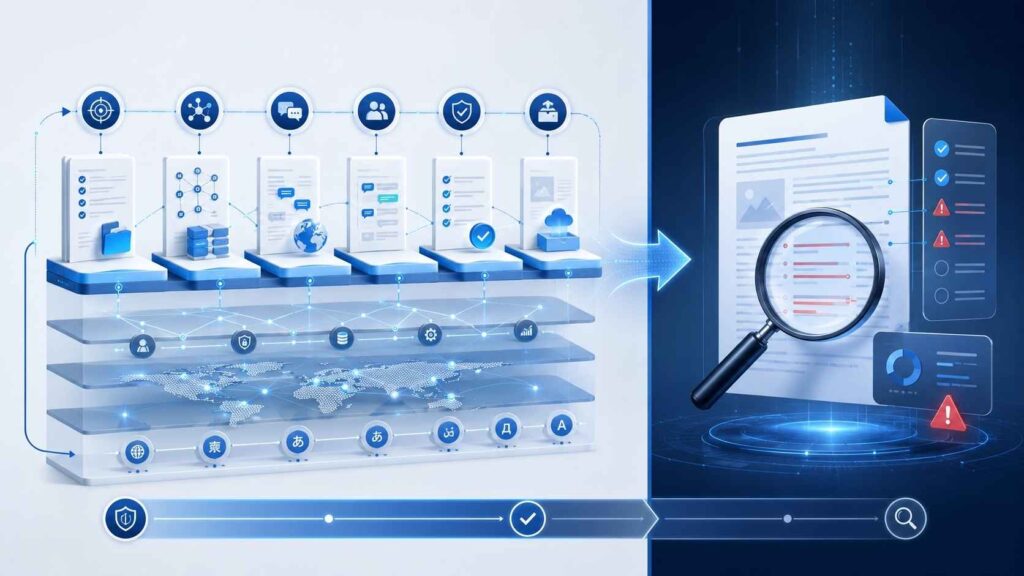
A mature TQA process layers automated and human checks in a set sequence. Here is how it plays out in practice.
Automated Quality Checks
Before any human revision starts, the reviewer opens the document in the same CAT tool used for translation and runs automatic verification checks. The system flags variables across categories (omissions, segments over the maximum character limit, unnecessary spaces, wrong punctuation, number mismatches, and tag errors) using built-in QA plus dedicated tools such as Xbench or Verifika. Mechanical errors are detected automatically, allowing our human experts to focus on the decisions that require linguistic expertise and subject-matter judgment.
Human Linguistic Review
Next, qualified linguists compare source and target to verify what no automated check can fully judge: meaning, terminology in context, and consistency. Reviewers check compliance with glossaries and instructions, correct language for the target audience, and the full error taxonomy of terminology, accuracy, fluency and style. Depending on the service level and the depth of check required, review covers anywhere from 25% to a full 100% of the text. Our professional translation services are structured around three defined tiers:
| Service tier | What is checked | Coverage | Best for |
| Translation + Review | Linguistic check of the target text against the source | 25% / 50% / 75% / 100% | Standard professional content, technical documentation |
| Translation + Revision | Linguistic check of the target text only (no source comparison) | 24% / 49% / 74% / 99% | Previously translated content, lighter review cycles |
| Translation + QA | Non-linguistic check against the source: formatting, numbers, completeness, consistency | 98% | High-volume structured content |
The workflow we deliver always matches the service the client agreed to. If a lower workflow is needed for a specific reason (urgency, for example), the client is informed and confirms before we proceed.
In-Context Testing and Validation
For software, websites and eLearning, text behaves differently once it sits inside the real interface. In-context linguistic testing and validation confirm that translations display correctly, fit their containers, render right-to-left languages properly, and read naturally inside the live product rather than in an isolated segment.
Final Approval and Delivery
The process closes with a final review, client-specific checks, delivery validation, and an evaluation step. Every job is rated by the person in the next workflow step, feedback is logged, and any non-conformity is documented and routed for corrective action. That keeps the improvement loop alive instead of letting issues vanish after delivery.
Translation Quality Assurance Tools and Technologies
Technology is what makes consistent, scalable QA possible. The right stack pairs real-time checks with centralised assets and intelligent automation.
Translation Management Systems and QA Features
A Translation Management System (TMS) is the operational backbone of QA. It enforces workflows, stores project data and evaluations, tracks review percentages, and surfaces progress and quality metrics on project dashboards with automated deviation alerts. CAT tools with built-in QA catch terminology, formatting and consistency errors live, as the linguist works.
AI-Powered Quality Evaluation and Automation
AI has changed what a QA toolkit can do. Automatic Quality Estimation (AQE) scores translations in real time to predict where human attention is needed most, while Automatic Post-Editing (APE) and machine translation post-editing workflows speed up high-volume content. Used well, AI does not replace quality judgment, but rather points human expertise to where it adds the most value.
Terminology Management and Translation Memories
Centralised translation memories enforce consistency across every project and language, while terminology databases enforce approved term usage with automated validation. Together they are the biggest single lever for quality and efficiency: they cut errors, lower cost through reuse, and make sure that a term approved once is then reused correctly everywhere, across offices, projects, and time.

Best Practices for Improving Translation Quality Assurance
These practices consistently lift quality outcomes while keeping cost under control.
Establish Clear Quality Standards
It is not possible to assure a level of quality that has never been defined. The table below shows the core KPIs we track and the targets we govern through SLAs.
| KPI | What it measures | Typical target |
| On-time delivery | Percentage of projects delivered on or before the agreed deadline | 98%+ |
| Linguistic quality (LQA) | Error rate per word or segment, scored against an error typology framework | Client-defined threshold per content type |
| First-pass yield | Percentage of files that pass review without requiring a review cycle | Tracked per language pair and service tier |
| TM leverage rate | Percentage of content reused from translation memory | Tracked per project; higher = lower cost |
| Client satisfaction | Ratings, complaint rate and escalation rate | Tracked per project; complaint rate minimised |
| Query response time | Time to respond to client queries and issues | Per agreed SLA thresholds |
Keep the core principle in view: assurance means hitting the agreed quality level reliably, not chasing perfection on every single job.
Build and Maintain Terminology Databases
Treat terminology as a living corporate asset. Invest early in glossaries, naming manuals and translation memories, keep them current, and enforce them automatically. The payoff compounds, because every future project inherits the accuracy and consistency that is built today.
Combine AI Efficiency with Human Expertise
The strongest QA model is not fully manual, and it is not fully automated either. Automated checks handle scale, speed, and mechanical verification. Human experts stay on meaning, nuance, cultural adaptation, and high-stakes content. We calibrate this balance to each service, from 100% human review for critical material to AI-led flows for high-volume data. That is how quality and efficiency stop competing with each other.
Protect Confidential Content During QA Processes
QA often touches a company’s most sensitive material: patents, contracts, clinical data, and unreleased products. Public AI tools can expose that content or feed it into model training, which is why we process it instead in private, controlled environments where data stays isolated from public engines. This is especially relevant for companies managing intellectual property assets, where confidentiality is as important as linguistic accuracy. Our secure AI platform operates under ISO-certified information-security protocols and full GDPR compliance. Confidentiality is not an add-on to quality assurance. It is part of it.
Quality Assurance in the Age of AI
AI has changed the central question of quality assurance. The old question was, ‘Does this translation contain errors?’ The new one is, ‘Can we trust this production flow?’ Assuring quality in an AI-driven workflow means governing the models in use, the data they are trained and run on, the prompts, the control mechanisms, the points of human intervention, and the traceability of every decision. Quality requirements now have to flex across very different services (human translation, MTPE, localization, and AI-generated content), each with its own assurance framework. The companies that come out ahead are the ones that can prove their process is trustworthy, not just spot-check the output.
Translation Quality Assurance: Common Questions Answered
How Is Translation Quality Measured Across Languages?
Quality is measured against defined standards using structured error-typology frameworks (covering terminology, accuracy, fluency, and style) alongside metrics such as LQA error rates per word or segment, first-pass yield, and TM leverage. Scores are normalized so the same benchmark applies across every language pair, with second-linguist review keeping assessment standard across teams and offices.
What Is the Difference Between Linguistic QA and Functional Testing?
Linguistic QA judges the language itself: meaning, terminology, grammar, style, and cultural fit. Functional testing, or in-context testing, checks that the translated text works inside the real product, so it displays properly, fits its UI containers, handles right-to-left scripts, and breaks nothing in the layout or code. Comprehensive QA for software and digital content needs both.
Can AI Replace Human Translation Quality Assurance?
Not entirely, but it does transform it. AI is excellent at automated checks, quality estimation and processing volume at speed, which makes QA faster and easier to scale. What it cannot fully replace is human judgment on meaning, nuance, cultural fit, and high-risk regulated content. The most reliable model pairs AI efficiency with human expertise and full traceability over models, data, and decisions.
How Often Should Translation Assets Be Reviewed and Updated?
Core assets (glossaries, translation memories, and style guides) should be maintained continuously, not on a fixed annual cycle. Update them whenever products, branding, regulations, or terminology change, and review them as part of regular quality cycles. Treating them as living assets is what keeps their consistency and reuse high over time.
Which Industries Require the Strictest Translation QA Processes?
The most rigorous QA is used on regulated, high-risk sectors: life sciences and pharmaceuticals (patient safety, ISO 13485), legal and intellectual property (precision and confidentiality), automotive and heavy machinery (operational safety), and finance (regulatory accuracy). In these fields, certified processes, specialised subject-matter reviewers, and full auditability are not optional. They are a requirement.


There are no comments
Leave a comment