
When a company operates across three markets, translation is manageable. At ten markets and twenty languages, it becomes core infrastructure. The difference between organizations that scale translation successfully and those that drown in backlogs is rarely budget. It’s workflow design.
In over 35 years working with global enterprises, we’ve seen the same patterns repeating. Companies that invest in a sound translation workflow from the start spend less over time and achieve better output. Those that don’t keep rebuilding from scratch.
This guide walks through how to structure a scalable translation workflow: from content intake to final delivery, including a practical framework for deciding when human translation is the right investment and when machine translation is the faster and safer call.
Translation workflow: definition and core components
What is a translation workflow in enterprise contexts?
A translation workflow is the end-to-end process that governs how content moves from source to translated output. It covers who initiates requests, how they are routed, what quality checks apply, and how translated content reaches its final destination.
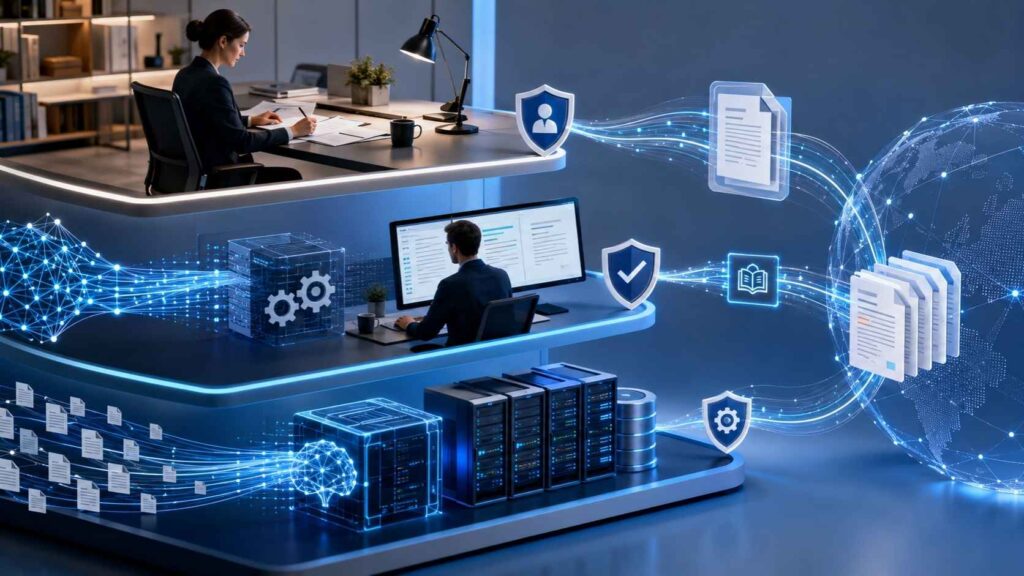
In enterprise environments, it’s not a single process but a system of interconnected processes, roles and technologies. It functions as the orchestration layer connecting people, AI, language technology, and enterprise systems into a governed multilingual operating model It defines who submits translation requests, how those requests are classified and prioritized, which translation method applies to each content type, and how approvals are managed across markets. It also orchestrates the interaction between the client’s and the language service provider’s technology ecosystems, including content management systems, translation management systems, AI and machine translation engines, terminology databases, quality assurance tools, and other business applications.
An enterprise workflow differs from a basic one in three ways: it is documented and repeatable, it is governed with clear ownership and it is integrated into existing business systems like CMS, ERP, or PIM platforms.
Translation workflow vs translation process: key differences
These terms get used interchangeably but they describe different things. The translation process is the linguistic work: analysis, transfer, revision. The translation workflow is everything around that: project management, technology, approval chains, and delivery logistics.
A company can have excellent translators and still have a broken workflow. In our experience most scaling problems happen outside the linguistic work itself.
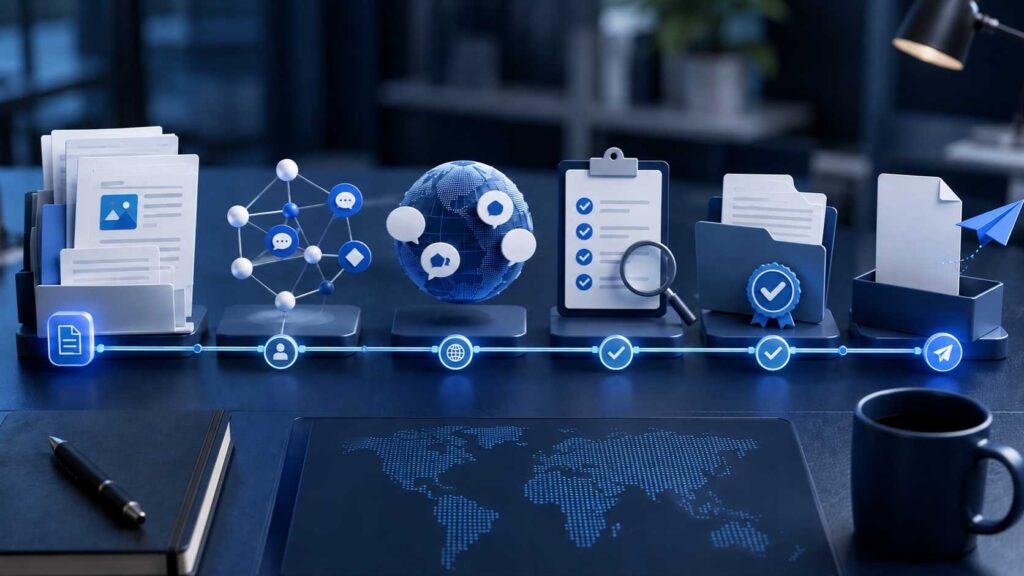
The 5 stages of a professional translation workflow
Stage 1 — Content intake and request routing
Every translation request enters the workflow through an intake point. In unstructured environments this is often an email inbox. In the organizations we work with it’s a request portal integrated directly with the TMS.
Good intake captures the content type, target languages, deadline, and word count. That’s enough to route the request correctly without back-and-forth. Without documented routing logic the decision defaults to whoever is available, which is not a system.
Stage 2 — Translation: human, machine, or hybrid
The choice of translation method is no longer simply a decision between human translation and machine translation. Modern enterprise workflows orchestrate AI models, machine translation engines, human expertise and quality controls according to business rules, content risk, and quality requirements. Policy-based routing determines which engine, workflow, and level of human involvement are appropriate for each content type.
The mistake we see most often is applying one method to all content: over-investing in human translation for internal documentation or running regulated content through MT engines without a defined quality threshold.
Stage 3 — Linguistic review and quality assurance
Review requirements vary by content type. Tier 1 content requires full human review by a specialist. Machine Translation Post-Editing (MTPE) output requires post-editing by a qualified specialist to the level of quality defined for the project. Light post-editing focuses on achieving content that is fit for purpose, while full post-editing aims to produce output comparable to the quality of human translation.
Automated quality tools including terminology validators and AI-based quality estimation can run prior to or in parallel with human review. They flag issues that would otherwise need detection pass by pass.
Stage 4 — Approval, compliance, and legal review gate
High-stakes content often requires sign-off beyond the linguistics team. Legal, compliance, or subject matter experts review translated content for regulatory accuracy, brand alignment, or market-specific compliance. This gate is separate from linguistic QA: it evaluates whether the content is correct in the target market context, not just linguistically accurate.
We’ve seen this stage skipped as a cost-cutting measure. The corrections it creates downstream cost more than the review would have.
Stage 5 — Final delivery and publishing
A scalable workflow automates as much of the delivery stage as possible. Beyond connecting the TMS with CMS, ERP, or PIM platforms, modern multilingual workflows orchestrate APIs, enterprise applications, and AI services, allowing content to move securely across the organization without manual intervention.
Why translation workflows break when teams go global
The hidden cost of manual routing and ad hoc decisions
When there is no documented routing logic every request becomes a negotiation. Project managers make decisions based on availability or habit rather than content type or risk level. The result is inconsistent quality, unpredictable costs, and no data to improve on.
The hidden cost is not the rework alone. It’s the coordination overhead: teams spread across multiple time zones spending time on routing decisions that a documented system would handle automatically.
Single-vendor lock-in and technology rigidity
Committing to a single MT engine or TMS vendor creates a dependency that limits flexibility as business requirements evolve. Translation technology changes fast. Engine performance varies significantly by language pair and content domain. The best engine for Spanish legal content may not be the best for Japanese technical documentation.
At Seprotec, we work as a technology-agnostic Language Intelligence Partner. Rather than promoting a single platform or AI engine, we advise clients on how to orchestrate the most appropriate combination of AI models, language technologies, workflows, and human expertise for each use case. This independence allows organizations to evolve their technology stack without vendor lock-in.
Terminology inconsistency across markets and departments
Without a shared terminology database each department builds its own vocabulary in each language. Marketing uses one term, legal uses another and the product team uses a third. Across twenty languages this becomes compounded into brand and compliance risk that is expensive to untangle.
Centralized termbase management integrated into the TMS and accessible to all translators is one of the highest-leverage investments a global team can make in translation quality.
How to design a content tier model for your translation workflow
No single workflow fits all content types. A content tier model classifies documents by risk level and communication importance then assigns the appropriate workflow to each tier. This removes routing decisions from individual judgement and makes the process repeatable at scale.
We use a three-tier model with our enterprise clients, adapted to each organization’s risk profile and content mix.
Tier 1 — High-stakes content: human-only translation
Legal agreements, regulatory submissions, patent filings, executive communications, and clinical documentation require human-only translation. The cost of error in these content types outweighs any efficiency gain from automation, whether that cost is legal, financial, or reputational.
Tier 1 content also requires subject matter expertise. A translator who specializes in pharmaceutical regulation or IP law rather than a generalist.
Tier 2 — Standard content: hybrid MT and post-editing
Marketing materials, technical documentation, customer support content, and standard product descriptions work well in a hybrid approach. Machine translation generates the draft; a human post-editor corrects errors, adapts tone, and verifies terminology against the approved glossary. Turnaround times drop significantly without compromising quality.
Hybrid workflows perform best when the MT engine is fine-tuned on domain-specific content and aligned with the company’s termbase.
Tier 3 — High volume, low risk: machine-governed translation
Internal communications, metadata, product categorization data and operational content at high volume can be processed with machine translation and automated quality validation. This is where the largest volume and speed gains occur and where organizations recover the cost of quality investment in Tier 1.
How to classify your content across tiers
Classification should be documented and agreed across departments before implementation. Five criteria cover the majority of routing decisions: audience (internal vs external), regulatory exposure, brand sensitivity, volume, and language pair complexity. A decision matrix covering these dimensions removes the need for case-by-case escalation.
Technology stack for a scalable translation workflow
Translation management systems as the workflow backbone
A translation management system orchestrates the workflow from intake to delivery. It stores translation memories, manages glossaries, tracks project status, and routes content to the right resource. Without a TMS, workflow management relies on spreadsheets, email threads, and institutional memory. None of those scale past a certain volume.
Key selection criteria for an enterprise TMS: API connectivity with existing business systems, support for multiple MT engine integrations, and workflow configuration that matches the tier model.
Machine translation engines and private AI environments
Not all MT engines perform equally well and not all MT environments are equally secure. Public and consumer-grade translation tools typically process submitted content under terms that permit use of that data for service improvement. For enterprise content this creates a data sovereignty risk that most internal security policies have not yet addressed.
Our seprotec.ai platform is just one component of a broader multilingual technology ecosystem. As a technology-agnostic Language Intelligence Partner, we integrate the most appropriate AI models, language technologies and enterprise systems according to each client’s operational, quality and security requirements. Content processed through seprotec.ai remains within a private closed environment, never enters shared model training data, and stays within the client’s agreed data processing framework.
CMS, ERP, and PIM integrations for automated delivery
The final step of the workflow involves moving translated content back into the publishing system. This is where manual errors tend to accumulate most. Integrations between the TMS and business systems like CMS, ERP or PIM automate this step and eliminate file handling errors, duplicate uploads, and version mismatches.
Translation workflow governance for global teams
Defining ownership: who manages the translation workflow?
In most enterprises translation sits between departments. Increasingly, governance also extends to AI: organizations need clear ownership of AI policies, model selection, terminology governance, data governance, and multilingual quality standards alongside the operational workflow.
Assigning a single workflow owner, typically a Translation Manager or Localization Director with cross-functional authority, resolves the majority of coordination failures before they reach production.
Centralized vs decentralized translation governance models
Centralized governance means one team manages all translation requests, vendor relationships, and quality standards. Decentralized governance distributes that responsibility to regional or business unit teams.
Most global organizations we work with operate a hybrid system. A central Centre of Excellence sets standards, manages technology, and owns key vendor relationships, while regional teams execute within those standards. This preserves local agility without creating terminology drift across markets.
Key roles: translation manager, vendor manager, terminology owner
Three roles are critical to workflow function regardless of team size. The Translation Manager coordinates requests and resources. The Vendor Manager manages external LSP and technology relationships. The Terminology Owner maintains the termbase and ensures consistency across languages and content types.
In smaller organizations one person holds all three. What matters is that the responsibilities are assigned, not that they map to separate headcount.
Best practices for scaling your translation workflow
Standardize before you automate
Automation makes processes faster. The objective, however, is not to accumulate more AI tools but to orchestrate the right combination of technologies within a governed multilingual operating model. Standardize the workflow, define governance and classification rules, then automate.
Build reusable assets: translation memories and glossaries
Translation memories store previously approved translations of recurring segments. Glossaries enforce terminology consistency across languages and translators. Both assets compound in value over time: the longer they’re maintained, the more leverage they provide against new volume.
In our experience clients who maintain these assets properly reduce translation costs by 20-30% over two to three years without changing their vendor or fundamentally altering their process.
Combine AI efficiency with human expertise
The most effective enterprise translation workflows are neither fully automated nor fully human. AI handles volume, consistency, and speed. Human expertise handles nuance, risk, and domain complexity. The tier model determines where each applies.
Monitor workflow performance with quality and volume metrics
Scalable workflows are data-driven. Useful metrics include words translated per month by tier and language, cost per word by tier and vendor, turnaround time against agreed SLAs, and error rates per review pass. These figures surface bottlenecks, validate tier classification decisions, and support budget conversations with finance.
What global teams ask when scaling translation operations
What are the steps in a professional translation workflow?
The core steps are content intake, routing decision, translation (human, MT or hybrid), linguistic review, compliance or SME approval, and final delivery. Enterprise workflows add upstream steps for request classification and termbase validation, plus downstream automation connecting the TMS to the publishing system.
When should you use machine translation instead of human translation?
Machine translation is appropriate for high-volume lower-risk content where turnaround speed is the priority and the output will go through a human review pass before publication. Human-only translation is appropriate for regulated content, brand-critical materials, legal documentation, and any content where an error carries significant legal or reputational consequences.
What is a TMS and does every global team need one?
A TMS automates workflow routing, stores translation memories, manages project timelines, and integrates with business systems. Teams translating under 20,000 words per month across two or three languages can often manage without one. Beyond that volume a TMS typically recovers its implementation cost within the first year through reduced coordination overhead and translation memory reuse.
How do you manage translation consistency across multiple languages?
A centralized termbase accessible to all translators and integrated into the TMS is the primary consistency mechanism. Combined with translation memories and language-specific style guides it ensures the same product names, brand terms, and concepts are rendered consistently regardless of who translated the content or when.
What is the difference between MT and MTPE?
MT is the automated output of a translation engine with no human intervention. MTPE is MT output reviewed and corrected by a human post-editor. MTPE comes in two forms: light post-editing corrects only critical errors while preserving the MT structure; full post-editing revises the output to near-human quality. Most enterprise workflows use MTPE rather than raw MT for any content reaching external audiences.
What is a Language Intelligence Partner?
A Language Intelligence Partner goes beyond delivering translation services. It helps organizations design, integrate, and govern multilingual operations by orchestrating AI, language technologies, human expertise, and enterprise workflows. The objective is to deliver measurable multilingual business outcomes rather than translation alone.
Transparency Notice
Artificial intelligence tools may be used to support the creation of some of the content published on this blog. All content is reviewed, adapted, verified, and approved by the Seprotec team, which assumes editorial responsibility for its publication.


There are no comments
Leave a comment