
AI interpreting: how it works, where it fits, and where human interpreters remain essential
AI interpreting—also called automated interpreting, machine interpreting, or real-time speech translation, is the translation of spoken language by software that combines automatic speech recognition, machine translation, and either synthetic speech or live captions. For event organizers and enterprise buyers, the key decision is no longer whether AI can interpret, but which meetings can safely rely on it, which cannot, and which call for a combination of both.
Drawing on three decades of multilingual event delivery, this guide breaks down how speech-to-speech AI functions, benchmarks where it fits, and outlines how to test platforms against real-world compliance, latency, and reputational risk. We offer the full range of solutions, from AI-only interpreting to on-site interpreters, and our experience, together with our knowledge of the solutions on the market, lets us advise on the right one for each need, once those requirements and the performance of the proposed technology have been assessed.
How AI interpreting works
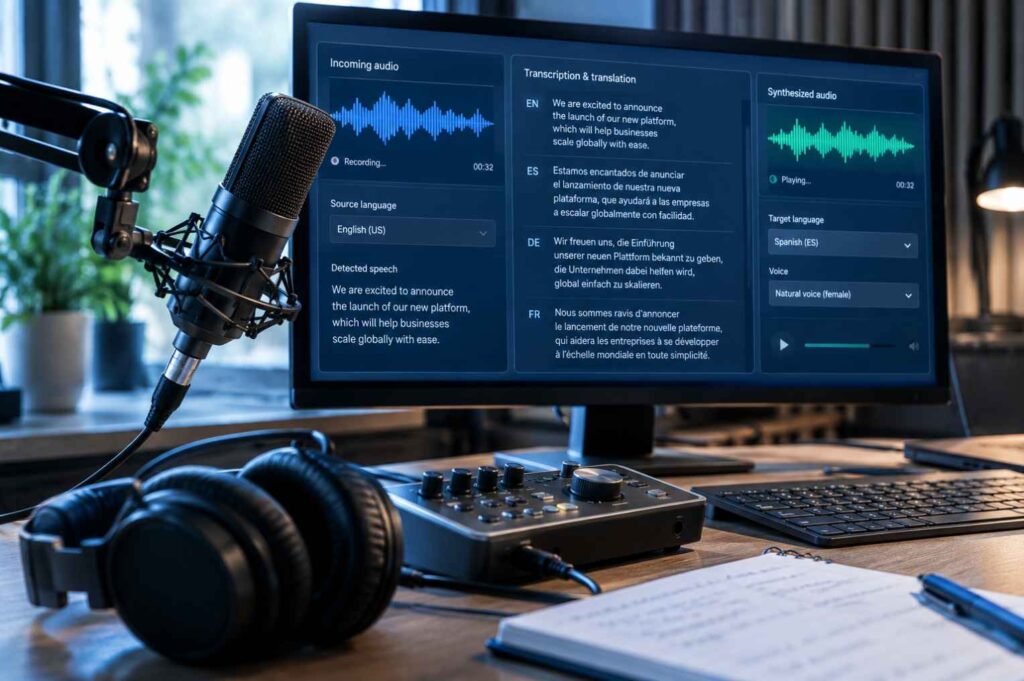
From speech to speech: recognition, translation, and synthesis
The process runs in three steps. Automatic speech recognition converts the speaker’s voice into text, machine translation renders that text in the target language, and the result is delivered as live captions or as synthetic voice. Each stage adds latency, and the end-to-end delay varies by platform, language pair, audio quality, speaking style, and output mode, so it should be measured in a rehearsal with the actual event setup.
What shapes quality: latency, accents, audio, and terminology
Quality depends on the whole chain, from a clean audio feed and speakers who pause without overlapping, to the accents involved and the vocabulary of the subject. Glossaries and speaker briefings can help improve results, while performance may vary significantly depending on the language pair and subject matter. This is why selecting an AI interpreting solution requires evaluating its capabilities against the specific requirements of each event, rather than relying on a one-size-fits-all approach.
AI interpreting versus human interpreting
The two approaches solve different problems:
| Criteria | AI interpreting | Human interpreting |
| Scalability | Adds languages with little extra effort | Each language needs a qualified interpreter or team |
| Accuracy and context | Performance varies by language pair, terminology, audio quality, and subject matter | Interprets meaning in context, adapting to terminology, speaker intent, and the communication setting |
| Nuance and tone | May miss irony, emotion, and idiom | Reads tone, intent, and cultural context |
| Accountability | Depends on vendor terms, deployment, monitoring, and review; no interpreter exercises judgment over every output | Works under professional, ethical, and contractual obligations defined for the assignment |
Where AI interpreting fits: a risk-based view
Low-risk, high-volume settings
AI interpreting can be considered for high-volume settings where the consequences of an error are limited, provided the actual language pairs and terminology are tested, participants are told how the service works, and an escalation path is available. Internal meetings, training sessions, webinars, and routine service exchanges such as scheduling are typical examples.
Settings that call for human interpreters
High-stakes environments—including legal proceedings, clinical consultations, cross-border negotiations, and diplomatic summits—demand near-zero tolerance for error. Highlighting these risks, an evaluation cited by the American Translators Association involving a World Health Organization trial of a commercial AI interpreting tool found that only one out of 90 tests achieved a passing grade, with even the passing test generating terminology errors that created reputational risk. While not a blanket indictment of all engine models, this underscores why human judgment remains non-negotiable where errors jeopardize legal standing, clinical outcomes, or organizational credibility.
Confidentiality: where the audio goes
Every AI interpreting solution processes audio and potentially transcripts, making data security and confidentiality essential considerations. Before selecting a platform, organizations should assess where data is processed and stored, how long it is retained, whether it may be used for AI model training, and which security and contractual safeguards are in place.
These requirements are particularly important for confidential business discussions, regulated industries, and institutional settings. A technology-agnostic approach allows organizations to evaluate different solutions against their specific security and compliance requirements rather than assuming that all AI interpreting platforms provide the same level of protection.
For a broader perspective on responsible AI adoption, including data protection, transparency, and human oversight, explore our article on Ethics in AI.
Hybrid models: combining AI and human interpreters
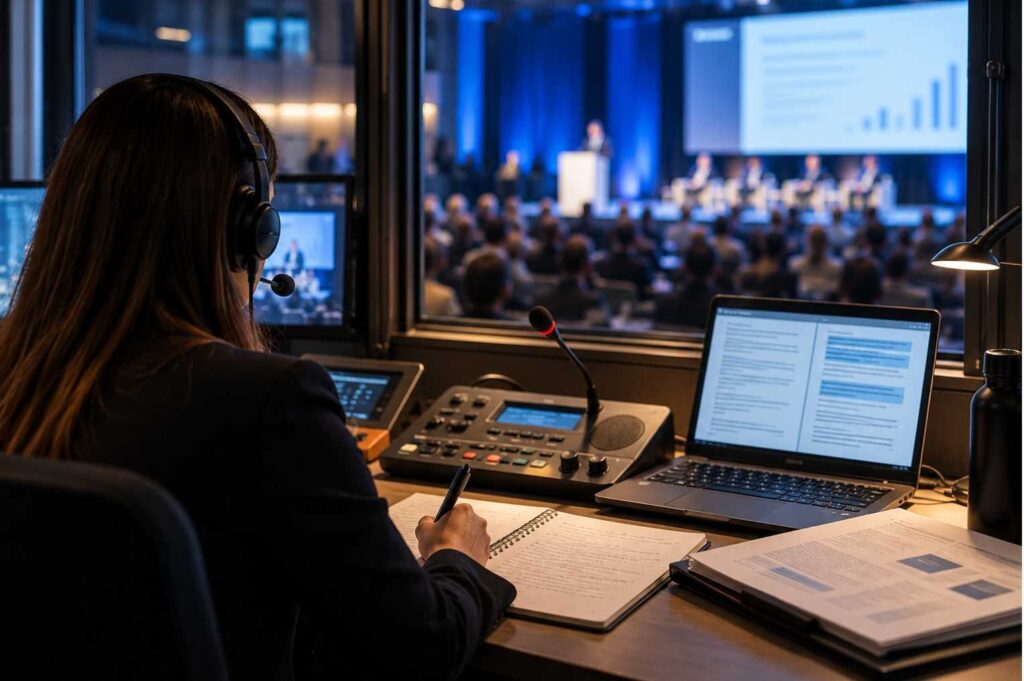
Four delivery models, from AI only to human only
We offer all four models and recommend one according to risk, audience, languages, and confidentiality. Availability, language pairs, handoff design, and service levels depend on the solution selected, so each model is validated for the specific event first:
- AI-Only: Real-time captioning or synthetic voice for low-risk, internal, or informational broadcasts where speed and budget take priority over stylistic nuance.
- AI with Human Interpreting Support: automated interpreting handles routine content, backed by a standby professional interpreter who can intervene or take over if dialogue becomes complex or critical terminology drifts.
- Human Interpreter with AI Support: Professional simultaneous interpreters utilize live automated transcription, automated term extraction, and instant glossary lookups to reduce cognitive load and enhance precision.
- Human-Only: Certified simultaneous or consecutive interpreting services, for diplomatic, judicial, clinical, or board-level engagements requiring absolute confidentiality and ethical accountability.
Interpreters themselves are experimenting with AI support: in a 2025 industry survey of linguists, 55% of the 53 interpreters who answered reported using AI tools, most often (19%) to look up terminology during delivery. The sample is small, so the finding is directional, and the survey notes that live transcripts can add to an interpreter’s cognitive load, which is why tools are best chosen with experienced interpreters.
How we combine AI and interpreters at multilingual events
As a Language Intelligence Partner, Seprotec helps organizations identify and implement interpreting solutions tailored to their event requirements. This involves assessing the audience, languages, subject matter, confidentiality needs, and technical environment, as well as evaluating the capabilities and limitations of the available technologies.
Depending on the solution selected, preparation may include terminology management, technical testing, speaker briefings, and arrangements for human interpreting support.
This approach draws on remote events we have delivered with professional interpreters: a Eurofront project webinar in five languages inside the client’s required platform, a UNIDO virtual conference for more than 1,200 participants in Arabic, French, and English, and a University of Exeter project conference with English and French simultaneous interpreting. These real-world deployments—such as delivering five-language interpreting on custom client platforms for the Eurofront project or coordinating simultaneous Arabic, French, and English feeds for over 1,200 UNIDO participants—demonstrate the operational infrastructure required for seamless remote delivery. Technology is only one layer; orchestrating the handoffs, audio feeds, and emergency protocols is what guarantees event success.
A buyer’s checklist for AI interpreting
These questions help compare solutions, and a partner with market knowledge can help answer them:
- What is at stake in the meeting, and who relies on the interpretation?
- Which language pairs, accents, and dialects will be spoken, and how is subject terminology handled?
- Is the output delivered as captions, synthetic voice, or both, and how does the tool connect to your meeting platform and audio equipment?
- Verify whether your audio streams or transcripts are retained, where servers are geographically located, and whether vendor terms allow your proprietary meeting data to train future foundational models.
- How quickly can a human interpreter step in, and who decides when?
- Ensure your language partner is tech-agnostic, recommending the best speech engine or human tier for your specific language pairs rather than forcing a proprietary tool.
How to test an AI interpreting solution before an event
A representative test shows more than a demonstration:
- Use sample audio from your own speakers, with their accents, pace, and background noise.
- Test every language pair with your glossary loaded, and check names, numbers, and dates, where errors are most costly.
- Measure latency, and the accuracy criteria the provider defines, in the actual event setup.
- Rehearse the fallback: who monitors the event and how a human interpreter takes over.
What organizations ask about AI interpreting
Is AI replacing interpreters?
AI is expanding access in some low-risk, high-volume settings. It is not an equivalent substitute where errors can affect rights, health, safety, legal position, or reputation; those contexts require qualified human oversight and often fully human interpreting, and our global interpreter network serves them.
Is AI interpreting accurate enough for business meetings?
For internal updates, training, or webinars, an automated solution may be acceptable once a representative test confirms that its accuracy, latency, terminology handling, and accessibility meet the event’s requirements. For negotiations, legal discussions, or regulated content, a single misrendered term can carry real consequences, so human interpreting remains the safer choice.
Is AI interpreting secure for confidential meetings?
Security depends on how a specific platform handles audio and transcripts, not on AI interpreting as a category. Confirm where data is processed, how long it is retained, and whether it trains models; for the most sensitive meetings, professional interpreters under confidentiality commitments remain the safer choice.
What are the main types of interpreting, and which can AI support?
The two main interpreting modes are simultaneous and consecutive interpreting. Other formats, such as whispered interpreting (chuchotage), are variations adapted to specific communication settings.
AI interpreting technologies are primarily used to provide real-time speech translation through live captions or synthetic voice, as well as support shorter, structured multilingual conversations. Their suitability depends on the communication context, language pair, and required level of accuracy.
Are free AI interpreter apps suitable for business use?
Consumer and free-tier apps may provide limited contractual control over retention, training use, terminology, support, and human fallback. Review the terms of the specific product before using it for business content; for confidential, regulated, or high-stakes meetings, choose a managed solution.
If you are planning a multilingual meeting or event, talk to our interpreting team and we will recommend the right mix of AI and human interpreters for your needs.
Transparency Notice
Artificial intelligence tools may be used to support the creation of some of the content published on this blog. All content is reviewed, adapted, verified, and approved by the Seprotec team, which assumes editorial responsibility for its publication.



There are no comments
Leave a comment